How to Identify Piano Chords: Name Any Chord You Play
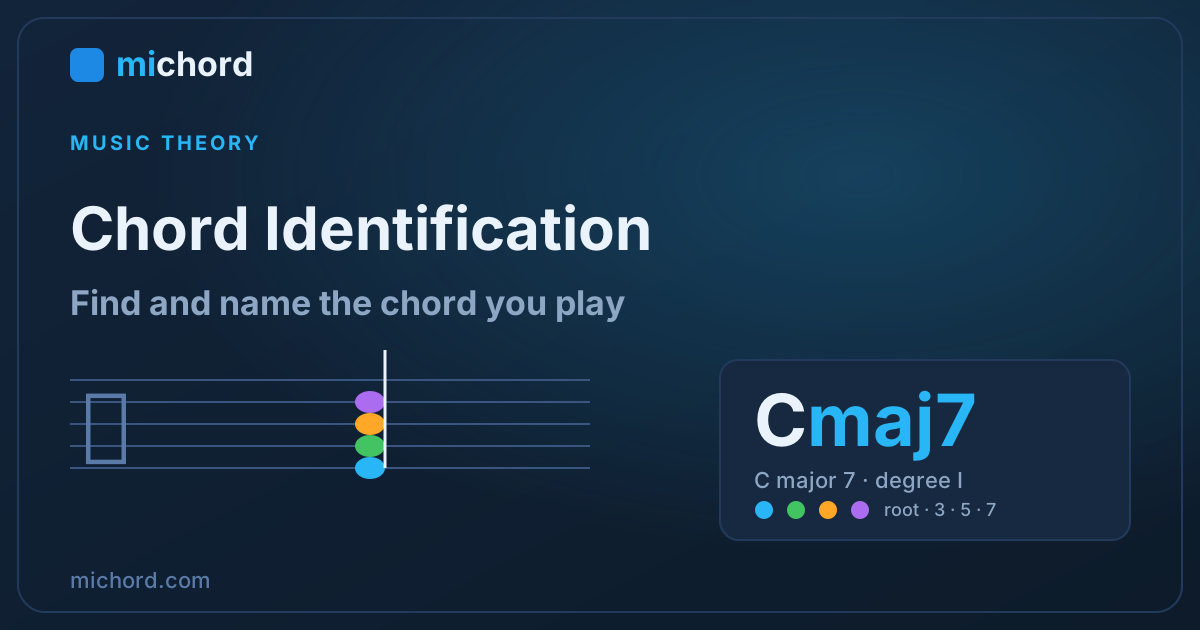
A chord is at least three notes played together. But figuring out which chord those notes form is a different skill. Most lessons show you how to press a major chord. The harder, more useful question runs the other way: how to identify piano chords by looking at the notes and matching them to the right name.
Demand for this skill keeps growing. The music learning apps market reached USD 1.85 billion in 2024 and is projected to grow at 13.2% annually, reaching USD 5.4 billion by 2033 (Growth Market Reports). More players than ever want to name chords fast.
In this guide you will learn to:
- Find the root and name any chord step by step
- Recognize inversions and seventh chords
- Read a chord's function within its key
What Is a Chord, and Why Is Naming One a Separate Skill?
A chord combines three or more notes heard at the same time. The most basic type, the triad, has three notes: root, third, and fifth.
Playing a chord and identifying one work in opposite directions. To play, you go from name to sound: you think "C major" and place your hand. To identify, you go from sound to name: you have the notes and must work out what they spell.
That reverse direction is exactly what most beginner material skips. Yet it is the skill you actually need when you improvise, play by ear, or analyze a piece.
Three parts anchor everything:
- Root: the note that gives the chord its name
- Third: the note a third above the root; it sets major or minor quality
- Fifth: the note a fifth above the root; it completes the frame
Identify the Chord You Played (Manual Method)
There is a reliable way to work out which chord your notes spell. This four-step routine is the core of how to identify piano chords, and it always works because chords are built in stacked thirds.
Step 1: Stack the notes in thirds. Rearrange the notes so each one sits a third (skip one key) above the last. If you hold E–G–C, restack them as C–E–G.
Step 2: Take the bottom note as the root. Once the notes stack cleanly in thirds, the lowest note is the root. The root is the bottom note of the chord in its stacked-in-thirds form (musictheory.pugetsound.edu).
Step 3: Check the quality of the third. The distance from root to third defines the chord's character:
- Major third: four half steps from the root (for example C–E)
- Minor third: three half steps from the root (for example D–F)
Step 4: Add the fifth and any seventh. Check whether the fifth is perfect, diminished, or augmented. A diminished fifth points to a dim chord; a wide fifth points to an aug chord. Now you can land on a full name like "C major," "D minor," or "B diminished."
These four steps break down even the densest chord. Remember the key rule: the chord's name comes from which notes are present, not their order.
Example: What Chord Is G–B–D?
Let's try a concrete example. You are holding G, B, and D.
- Stack in thirds: G–B–D is already stacked; G is the root.
- Check the third: G to B is four half steps, a major third.
- Check the fifth: G to D is a perfect fifth.
The answer is G major in root position. Play the same notes as B–D–G and the chord is still G major, just in first inversion. Repeat this with a few chords and your recognition becomes fast and automatic.
Recognizing Chord Inversions
A chord's notes can appear in any order. When the lowest note is not the root, the chord is inverted. Any chord with the same notes is the same chord, whatever the order.
To spot the inversion, look at the bass note:
- Root position: root on the bottom
- First inversion: third on the bottom
- Second inversion: fifth on the bottom, also called a six-four chord
A practical tip: when a chord stumps you, mentally restack the notes into thirds. The tightest stack reveals the root and therefore the real name.
Seventh and Extended Chords
Add a note a seventh above the root and you get a seventh chord. A seventh chord has four notes, which gives it three inversions.
The one you meet most is the dominant seventh: a major triad plus a minor seventh, carrying a strong pull toward the tonic. Other common types include:
- Major seventh (maj7): soft, bright color
- Minor seventh (m7): warm, jazzy texture
- Half-diminished (m7b5): tense, transitional
You build extended chords (9ths, 11ths, 13ths) by stacking more thirds on top of the seventh. Solving them by hand follows the same logic: stack the notes in thirds, find the root, and read the layers from the bottom up. The name grows longer, but the method never changes.
Functional Analysis: The Chord's Place in the Key
Naming the chord is half the job. The other half is seeing which degree it is within a key. This is functional analysis, and it labels chords with Roman numerals.
In the key of C major, for example:
- I (C major) is the tonic — home, rest
- IV (F major) is the subdominant — opening out
- V (G major) is the dominant — tension pulling back home
The same chord plays a different role in different keys. A G major chord is V in C major but I in G major. Functional analysis turns isolated chord names into real musical meaning.
Most beginner guides skip this layer entirely. Yet understanding why a chord belongs where it does sticks far longer than memorizing it.
By Hand or Instantly? Real-Time Chord ID With MIDI
The manual method builds lasting skill, but solving every chord in four steps is slow in practice. That is where real-time tools help.
Connect a MIDI keyboard to your computer, and the right app reads your notes instantly. It shows the chord name, writes the notes live on the grand staff, and marks the function in the key with a Roman numeral.
The two approaches complete each other:
- The manual method plants the theory in your mind
- A real-time tool confirms what you played and speeds up learning
Michord fills exactly this gap: it turns the notes you play on a MIDI keyboard into live notation, chord symbols, and functional analysis. So the method you learn by hand gets reinforced with instant visual feedback every time you practice. You can explore all features on the homepage.
Common Mistakes
When you learn how to identify piano chords, a few traps trip up most players:
- Reading notes without stacking them: guessing before you find the root leads to the wrong name.
- Mistaking an inversion for a new chord: reordering notes does not change the name.
- Confusing enharmonic spelling: F sharp and G flat are the same key but spelled differently by context.
- Ignoring the key: knowing the name is not enough; the function gives the musical meaning.
Conclusion
Identifying piano chords is an analytical skill that goes from sound to name, and anyone can learn it. In short:
- Stack the notes in thirds and take the bottom note as the root.
- Name the chord from the quality of its third and fifth.
- Spot the inversion from the bass note, and read the seventh layer in four-note chords.
- Use functional analysis to place the chord in its key.
Build the theory by hand, then confirm it with a real-time tool on every take. For more music theory guides, browse the music theory learning guide or the Michord blog. If you want to see every chord you play as instant notation, symbols, and analysis, try Michord and watch your learning speed up.
See every chord you play as instant notation, symbols, and functional analysis.
Try Michord FreeFAQ
How do I identify a chord I just played?
Stack the notes in thirds, take the lowest note as the root, then name the chord from the quality of its third and fifth.
How do I find the root of a chord?
When the notes are stacked in thirds, the bottom note is the root; the name stays the same even in inversions.
How can I tell if a chord is inverted?
Look at the lowest note. If it is not the root, the chord is inverted: third in the bass is first inversion, fifth in the bass is second inversion.
How do I tell a major chord from a minor chord?
Measure the distance from root to third: four half steps is major, three half steps is minor.
What is a seventh chord and how many inversions does it have?
A seventh chord has four notes and three inversions; the most common type is the dominant seventh.