Voice Leading Rules: Parallel Fifths, Octaves and How to Check Your Harmony
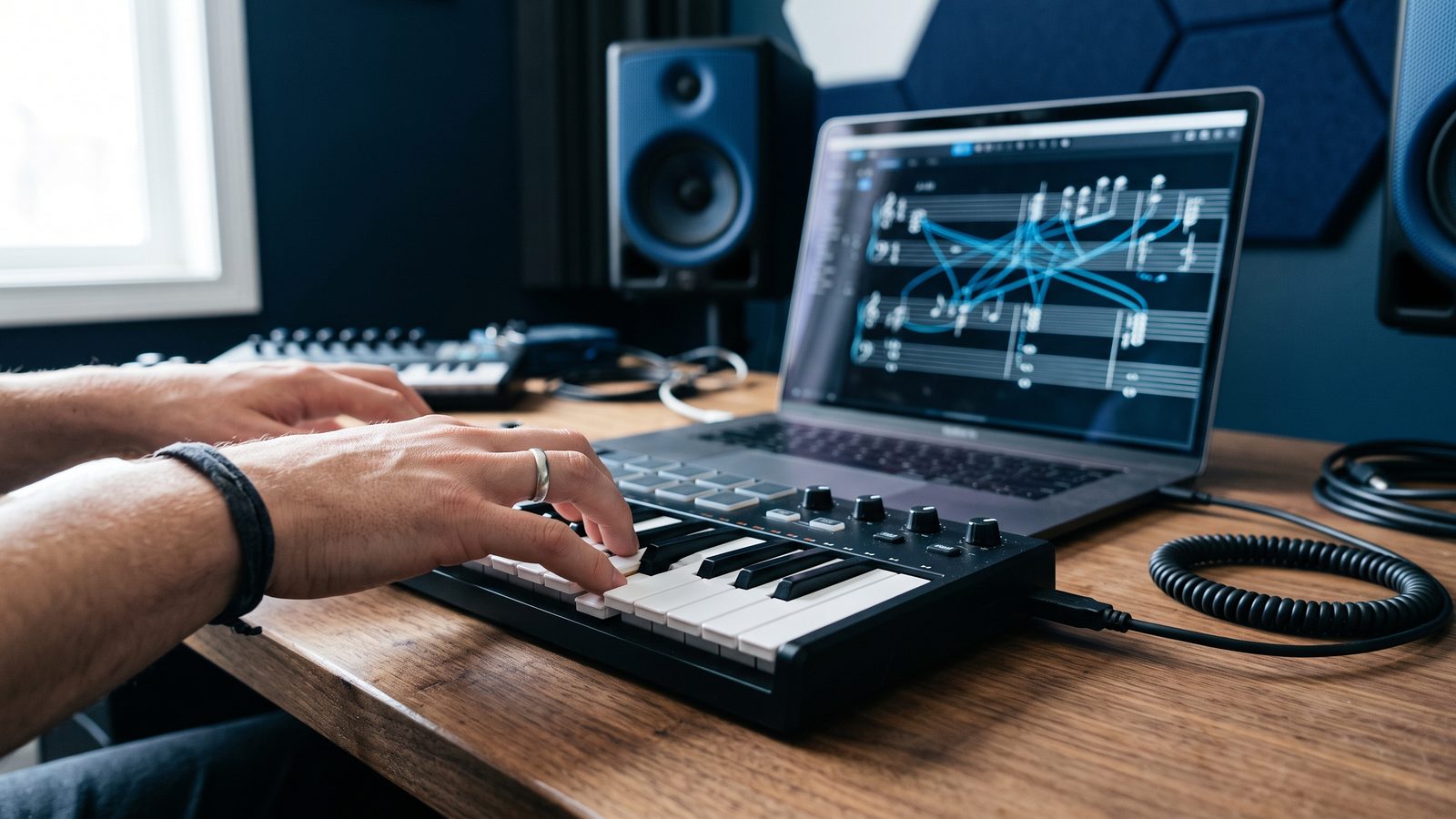
What are the voice leading rules? They are the conventions that keep soprano, alto, tenor and bass independent while they form chords. In practice: no parallel fifths or octaves, care with perfect intervals in the outer voices, and resolved tendency tones.
What is voice leading?
Voice leading is how each note of one chord moves to a note of the next. The progression decides which chords you use; voice leading decides how the four voices get there. Good voice leading keeps common tones and moves the other voices by the smallest reasonable step.
The AP Music Theory exam includes free-response questions on part writing from figured bass and on harmonizing a melody or composing a bass line. The Puget Sound open textbook is a good free reference, and functional harmony explains the chords themselves.
What are the four types of motion?
Every rule describes how two voices move against each other (see types of motion):
- Parallel: same direction, same interval (a third to a third).
- Similar: same direction, different interval.
- Contrary: opposite directions.
- Oblique: one voice holds while the other moves.
Parallel thirds and sixths are fine; the trouble starts with perfect intervals.
What are parallel fifths and octaves, and why avoid them?
Parallel fifths (or consecutive fifths) occur when two voices a perfect fifth apart move in the same direction to another perfect fifth. Parallel octaves are the same with octaves, and parallel unisons count too. A twelfth moving to a twelfth is still a parallel fifth.
The classic example is I to ii in C major: the bass moves from C3 to D3 while the soprano moves from G4 to A4. Both step up, from one (compound) fifth to another. If the tenor also rises C4–D4, it makes parallel octaves with the bass.
The fix is contrary motion: keep the bass and move the soprano down from G4 to F4, landing on a compound third. With alto E4–D4 and tenor C4–A3, no pair moves in parallel perfect intervals.
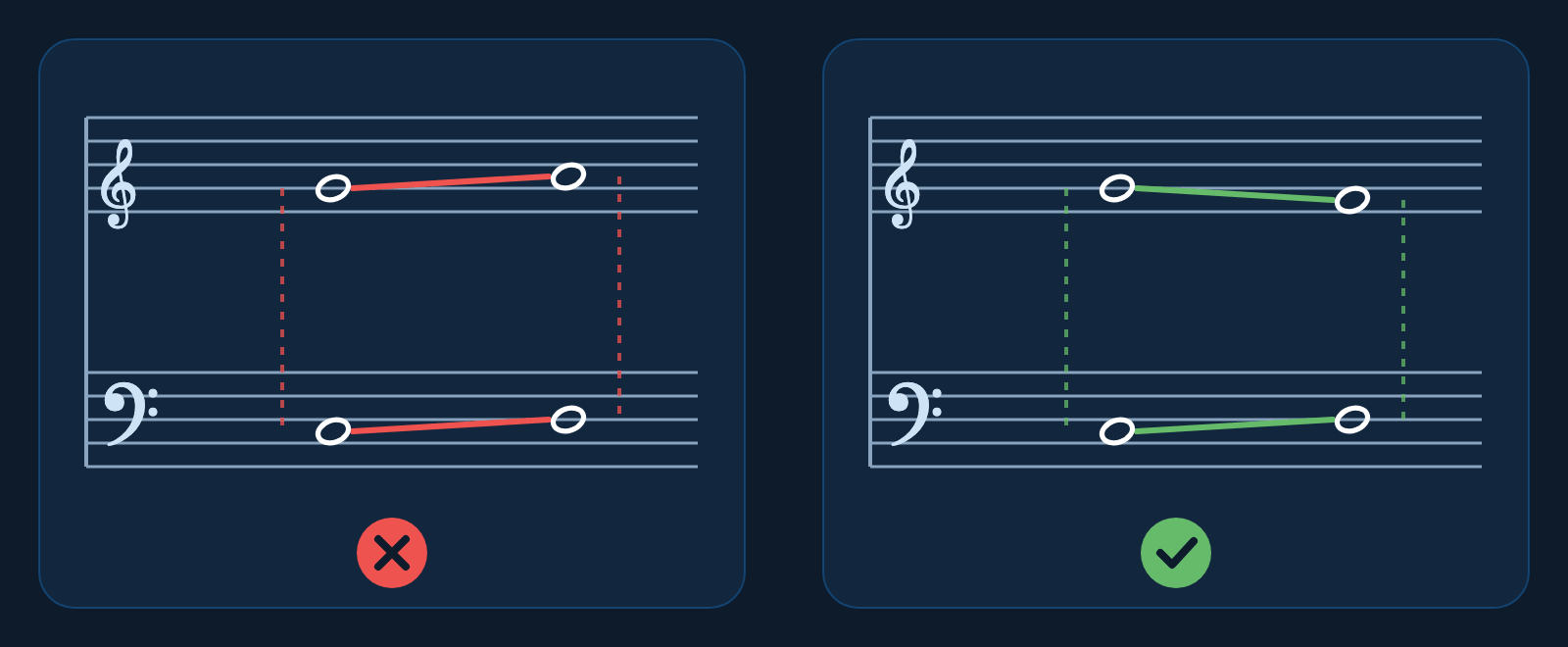
Why is it a rule? Perfect fifths and octaves blend so completely that two voices moving through them in parallel sound like one line (see objectionable parallels and consecutive fifths). The rule is stylistic: in rock, parallel fifths appear whenever a power chord slides to a new pitch (a single power chord is just one fifth).
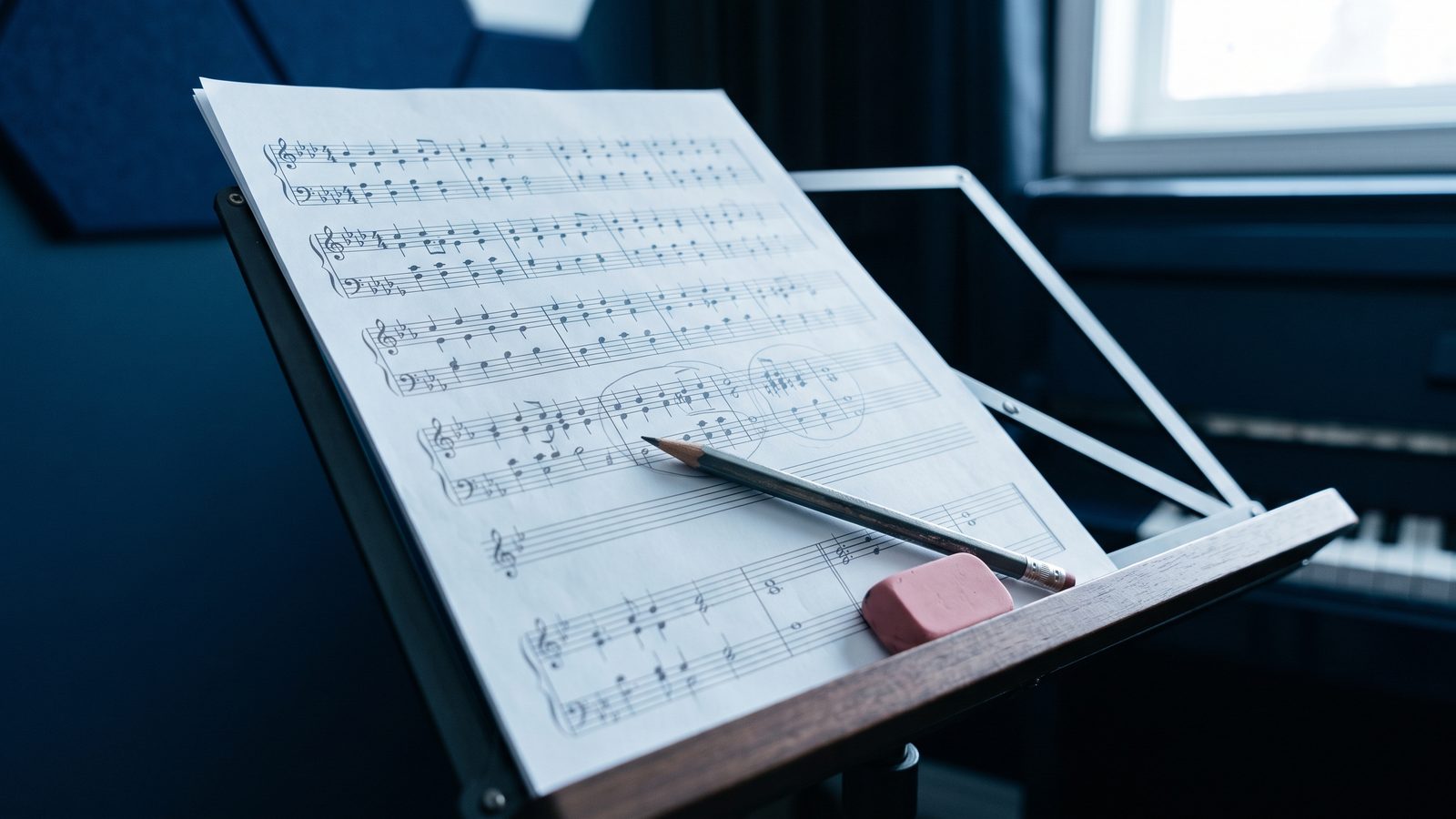
What are hidden (direct) fifths and octaves?
Hidden (or direct) fifths and octaves are reached by similar motion into a perfect fifth or octave from a different interval. Most textbooks only object in the outer voices when the soprano leaps.
Problem case, IV to V in C major: the bass steps up from F3 to G3 while the soprano leaps up from C5 to G5, arriving on an octave. Accepted case, ii to V: the bass rises from D3 to G3 while the soprano steps up from F4 to G4. Same octave by similar motion, but the soprano steps, so most teachers accept it.
How do the leading tone and the seventh resolve?
- The leading tone (scale degree 7) resolves up by half step to the tonic: in C major, B goes to C when V moves to I. Many textbooks let an inner-voice leading tone fall to scale degree 5.
- The seventh of a dominant seventh chord resolves down by step: in G7 to C, the F falls to E.
More context: the music theory guide.
What is the difference between voice overlap and voice crossing?
Voice overlap happens when a voice moves past the previous note of its neighbour: the soprano is on E, then the alto moves up to F while the soprano moves on to G. Voice crossing goes further: the alto actually sounds above the soprano, or the tenor below the bass. Exercises avoid both.
Voice leading rules at a glance
| Rule | What it means | Michord flag |
|---|---|---|
| Parallel fifths / octaves | Two voices move the same direction from a perfect fifth or octave to the same interval | Error |
| Hidden fifths / octaves | Outer voices move the same direction into a perfect fifth or octave while the top voice leaps | Warning |
| Voice overlap | A voice moves past its neighbour's previous note | Warning |
| Voice crossing | A voice sounds above the voice above it (or below the one below) | Not shown separately |
| Leading tone unresolved | V to I, and the leading tone in an outer voice does not rise a half step to the tonic | Warning |
| Seventh unresolved | The dominant chord's seventh does not fall by half or whole step | Warning |
Unisons: two voices on the same pitch are one key, so the chord arrives with fewer notes and is not compared with its neighbour.
How does Michord's Harmony Mode check voice leading?
On paper you compare six voice pairs at each chord change. Michord's Harmony Mode does it for the chords you play. It shows your last eight chords side by side on the staff, joins common tones with a green line, and names the cadence between neighbouring chords.
Turn on the Voice Leading button and Michord checks each pair of adjacent chords against these rules. Offending notes are marked on the staff with a short rule name such as "Parallel fifths" or "Seventh unresolved". Parallels are errors, the rest warnings. The check is rule-based.
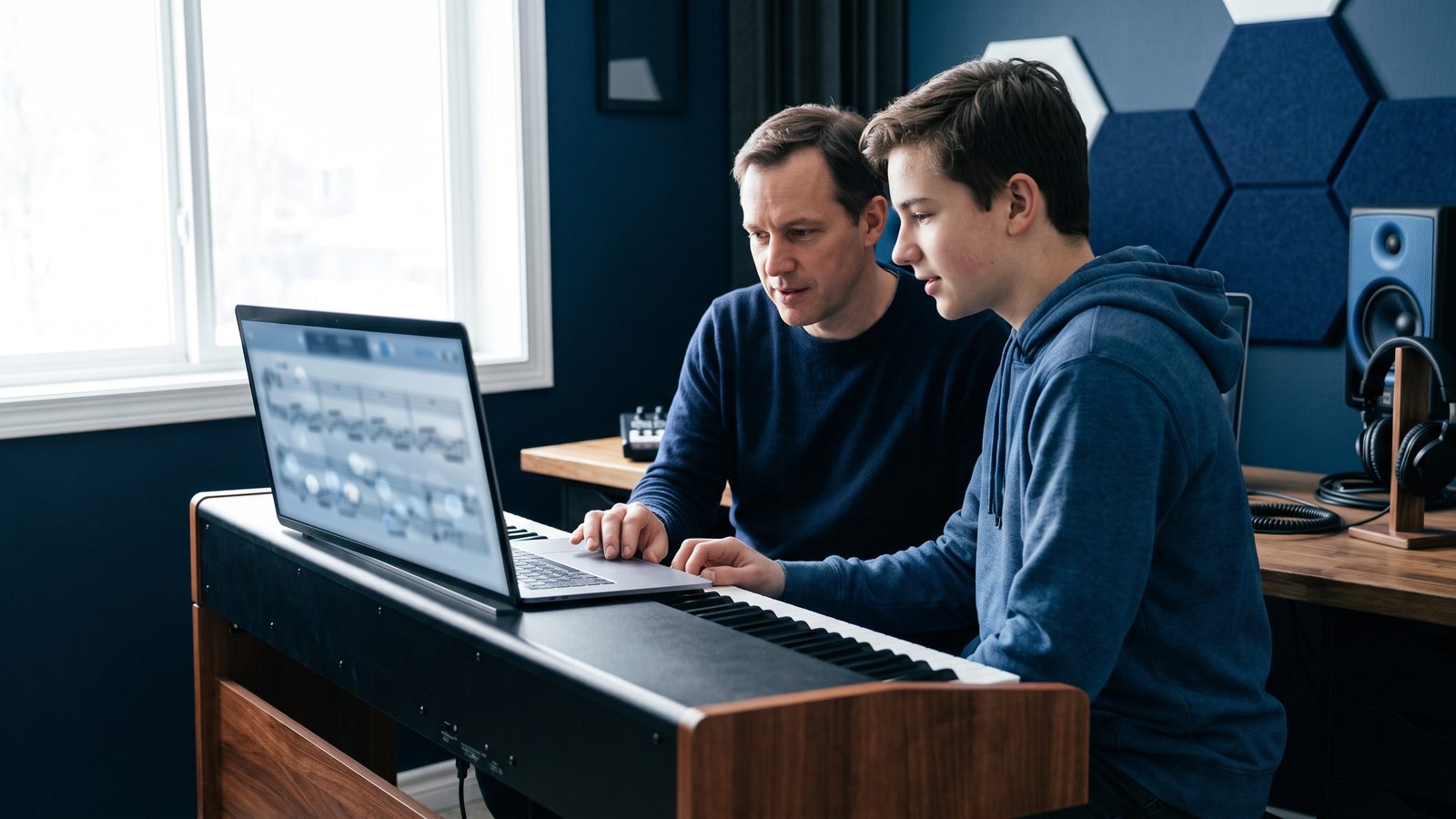
How do you check a four-part exercise step by step?
- Write the exercise on paper. The exam room has no app.
- Play each chord as four notes, voiced exactly as written, on a MIDI keyboard, the on-screen piano or your computer keyboard.
- Open Harmony Mode. It needs the staff, so it is unavailable in the "Chords only" view.
- Turn on Voice Leading.
- Read each flag and find the marked notes on your paper.
- Fix it on paper and play it again until the progression comes back clean.
What does Michord not check?
- It cannot read paper. You enter the exercise by playing it.
- It sees notes, not voice labels. Each chord is sorted from lowest to highest and voices are paired in that order. So crossing is not shown separately (overlap is).
- Contrary fifths and octaves are not flagged. Only same-direction motion counts as parallel, though strict teachers may still mark them.
- Different note counts are skipped to avoid false alarms: if adjacent chords differ in size, that pair is not checked.
- Doubling, spacing and range are still your job.
Which mistakes are most common?
- Only checking soprano and bass. Inner voices are easy to overlook, and their parallels count just as much.
- Moving every voice in the same direction. Aim for contrary motion against the bass.
- Doubling the leading tone. Both cannot resolve up without parallel octaves.
- Leaping to escape a parallel. A soprano leap can create a hidden octave instead.
How can teachers show voice leading in class?
Project Harmony Mode: play a student's progression, let the class find the problem, then turn on Voice Leading to confirm. The subscription also records the screen with audio (MP4). For entrance exams, see the music school audition preparation guide.
Conclusion
Avoid parallel perfect intervals, watch leaps into them, resolve tendency tones, and play your work back. Michord runs on macOS (Apple Silicon only) and Windows 10/11. The free plan (no credit card) covers MIDI keyboard, on-screen piano and computer keyboard input, a real grand piano sound and note names; Harmony Mode needs the subscription (2.99 USD a month or 22.99 USD a year, cancel any time). The Michord user guide covers setup, and how to identify piano chords shows the app as a chord finder.
Play your harmony exercise and see parallel fifths and octaves flagged on the staff.
Download MichordFAQ
What are the basic voice leading rules?
Move voices mostly by step, keep common tones, avoid parallel and hidden fifths and octaves, resolve the leading tone up and the seventh down, and avoid overlap and crossing.
Why are parallel fifths and octaves avoided?
The two voices blend into what sounds like one line, and four-part writing needs four independent voices.
Are hidden fifths and octaves always wrong?
No. Most textbooks only object between the outer voices when the soprano leaps. Michord warns in exactly that case.
Which rules does Michord check?
Parallel fifths and octaves (errors), plus hidden fifths and octaves, voice overlap, an unresolved leading tone and an unresolved seventh (warnings). Fifths and octaves in contrary motion are not flagged.
Is the voice leading check free?
No. Harmony Mode and the voice leading check come with the subscription: 2.99 USD a month or 22.99 USD a year, cancel any time. The free plan (no credit card) covers MIDI keyboard, on-screen piano and computer keyboard input, a real grand piano sound and note names.
Which computers does Michord run on?
macOS on Apple Silicon only, and Windows 10/11. There is no mobile app.
Can Michord read my written homework?
No. You play each chord and Michord checks what you play. Use it as an answer key, not a replacement for your teacher.
Sources
- College Board, AP Music Theory Exam, accessed 15 September 2026.
- Robert Hutchinson, Music Theory for the 21st-Century Classroom (University of Puget Sound): Voice Leading, Types of Motion, Objectionable Parallels, accessed 15 September 2026.
- Wikipedia, Consecutive fifths, accessed 15 September 2026.