How to Find the Key of a Song From Its Chords
How do you find the key of a song from its chords? You treat the chord chart like evidence. The notes narrow the answer to two keys, and the dominant and the cadences pick one. This guide walks through that method in five steps, with worked examples you can check at the piano. It is for AP Music Theory and ABRSM students, audition candidates, songwriters and teachers.
What is the key of a song?
The key names two things: the tonic, the note and chord that feel like home, and the mode, major or minor. "A minor" means A is home and the music uses the minor scale built on A.
The key signature helps, but it cannot decide on its own. Every signature is shared by two relative keys: C major and A minor both have no sharps or flats, and G major and E minor both have one sharp (F♯). Puget Sound's pages on major key signatures and minor key signatures list them all. Chords settle what the signature leaves open.
How to find the key of a song from chords in 5 steps
- Write down the chords. Use the whole song, or at least a full verse and chorus. Example: Am – Dm – E7 – Am.
- Spell every chord and collect the notes. Am = A–C–E, Dm = D–F–A, E7 = E–G♯–B–D. Together: A, B, C, D, E, F, G♯. Mark every sharp and flat.
- Find the scale that holds all the notes. Without the G♯, these notes fit C major and its relative A minor. That gives you two candidates, one major and one minor.
- Look for the dominant. The dominant is a major chord or dominant seventh whose root lies a fifth above the tonic: G or G7 points to C, E or E7 points to A (minor). In a minor key the V chord is major because the seventh note is raised to form the leading tone, G♯ in A minor. A G♯ in an otherwise "C major" set of notes strongly suggests A minor.
- Check the first chord, the last chord and the phrase endings. A V–I (authentic) cadence confirms the tonic, and most songs end on it. Here E7 → Am closes the phrase, so the key is A minor. Puget Sound's Cadences page covers the cadence types.
If spelling chords is still slow, start with how to identify piano chords.

Which chord gives away the key?
| Clue | What it suggests | Example |
|---|---|---|
| V7 → I | Strong evidence for the tonic | G7 → C = C major |
| Major V in a minor-sounding song | The raised leading tone of a minor key | E or E7 with Am and Dm = A minor |
| First and last chord | Often the tonic, but not always | Song ends on G: G major is likely |
| Key signature | Narrows it to two relative keys | One sharp: G major or E minor |
| ♭VII major chord | Mixolydian color or rock borrowing, not a key change | B♭ in a song in C |
| A lone secondary dominant | A temporary V of another chord, not a new key | D7 before G in C major = V/V |
The secondary dominant row trips up many students. D7 contains F♯, which is not in C major, but it only points at G for a moment. See Puget Sound's Secondary Dominants page.
What are the diatonic chords in major and minor keys?
Once you have a candidate key, check that the chords fit its diatonic pattern. Minor keys usually borrow the major V from the harmonic minor scale.
| Mode | Roman numerals | Example chords |
|---|---|---|
| Major | I ii iii IV V vi vii° | C major: C Dm Em F G Am B° |
| Minor (harmonic V) | i ii° III iv V VI VII / vii° | A minor: Am B° C Dm E(7) F G / G♯° |
The full tables are in Puget Sound's Diatonic Chords in Major and Diatonic Chords in Minor. Our functional harmony guide explains why V pulls so strongly toward I.
Worked examples: four chord progressions
1. C – G – Am – F (looping). The notes fit C major or A minor. There is no G♯ and no E major chord, and the loop keeps landing on C. Key: C major, a I–V–vi–IV progression.
2. Am – Dm – E7 – Am. E7 (E–G♯–B–D) carries G♯, the leading tone of A, and it resolves to Am. Key: A minor, i–iv–V7–i.
3. G – D – Em – C. The D chord (D–F♯–A) brings one sharp, so the choice is G major or E minor. D moves to G and the song ends on G, with no D♯ anywhere. Key: G major, I–V–vi–IV.
4. F and G played together as one sound. F–A–C plus G–B–D gives F, G, A, B, C, D. Only C major and A minor contain all of them, so you cannot decide yet. The next chord will tell you: C points to C major, Am to A minor.
One chord never decides: G7 alone fits C major, C minor and A minor.
Tricky cases: modes, borrowed chords and capo
- Songs that start on vi or ii. Am – F – C – G may start on Am and still be in C major if the phrases resolve to C.
- Modal songs. Dorian and Mixolydian songs have a clear tonic but no standard major or minor scale. A major ♭VII (B♭ in C) is the usual sign; see Subtonic VII in Pop Music.
- Borrowed chords. Fm (iv) in C major borrows from C minor. It adds color without moving home.
- Modulation. A final chorus a whole step up is a real new key. Look for a new dominant and new cadences; Puget Sound explains how to recognize a key after a modulation.
- Guitar capo. Chord charts often show shapes, not sounding pitches. G shapes with a capo on the 2nd fret sound in A major.
- Transposing instruments (B♭ clarinet, trumpet) are outside this guide.
How do you find the key by ear?
Hum the note that feels like rest, usually the last note of the song. Find it on the keyboard and play the major and minor chords built on it: which one matches the ending? Then play V7 to that tonic. If it sounds like the song's own cadences, you have the key. Confirm with the five steps once you know a few chords.
How does Michord help (and what doesn't it do)?
Michord is a desktop chord finder. Play chords on a MIDI keyboard, the on-screen piano or your computer keyboard, and it names each chord live (symbol, inversion, notes) on a grand staff. In our own test, playing Cmaj7 (C–E–G–B) gave four fitting keys, C, Em, G and Am, which is why a single chord can't settle the question.
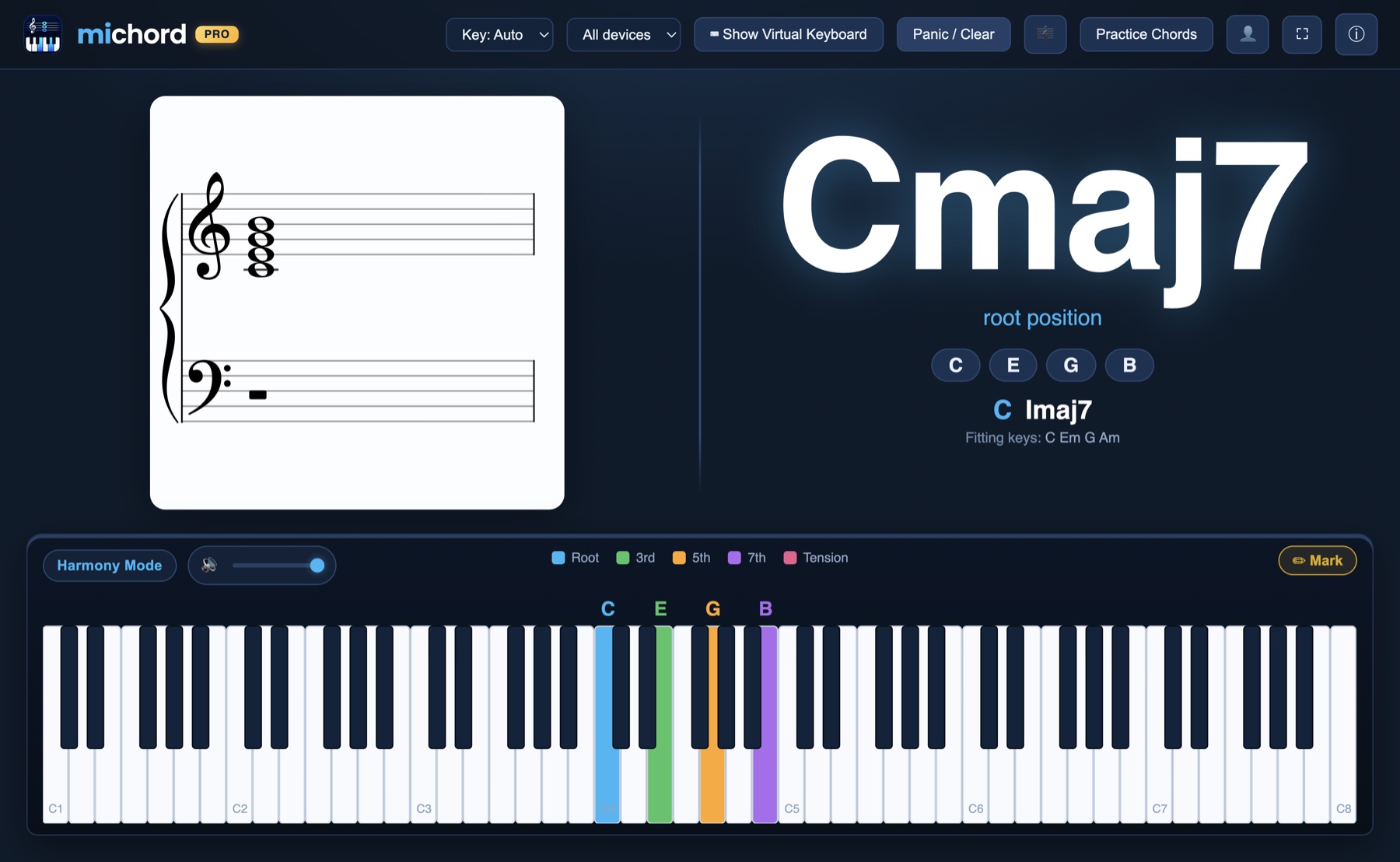
- Fitting keys. Michord lists every major and minor key that contains all the notes you are holding (minor keys include both the natural seventh and the leading tone), up to seven. The list comes only from the notes held at that moment; it does not add up across chords. Play each chord and note its fitting keys: the key that appears for every chord, and where the dominant resolves, is your answer. To get one combined list, hold several chords' notes together, like F and G in example 4.
- Key menu. "Key: Auto" picks the most likely key, or you choose one. Roman numerals follow that key.
- Deeper analysis. Functional analysis with key detection, secondary dominants and borrowed chords, cadence detection and modulation alerts are subscription (PRO) features.
- It does not listen. The analysis is rule-based, not AI. It does not analyze recordings, audio files, Spotify or YouTube, read photos or sheet music, or track rhythm and tempo. You play the chords; it analyzes those notes.
- Pricing. The chord panel with fitting keys, Roman numerals and key detection is part of the subscription: $2.99/month or $22.99/year, cancel any time. The free plan (sign-up, no credit card) covers MIDI keyboard, on-screen piano and computer keyboard input, a real grand piano sound and note names; each launch also gives two minutes of full access.
- Desktop only: macOS 11+ on Apple Silicon and Windows 10/11. No mobile app.
Setup is covered in how to use Michord.
A practice routine for finding keys
- Pick a song you know well and find its chord sheet.
- Write out the chords for a verse and a chorus.
- Work through steps 1–5 on paper and commit to an answer.
- Play the chords and note each chord's fitting keys; the key they all share should match your answer.
- Write Roman numerals under every chord in the key you chose.
- Repeat with a minor-key song and hunt for the major V.
The app is an answer key. There is no app in the exam room, so do the reasoning on paper first. For exam planning, see the music school audition preparation guide.
How can teachers use this in class?
Project the screen and play a progression one chord at a time. The class writes down the fitting keys of each chord, finds the key they all share, then checks the cadence. With the subscription you can record the screen with audio (MP4) and share it as a study clip.
Conclusion
Finding the key of a song from its chords is a short chain of reasoning: spell the chords, collect the notes, find the two relative keys, then let the dominant and the final cadence choose. Practice on songs you know. For the wider picture, see the music theory guide.
Play each chord of a progression and compare its fitting keys. Free plan with no credit card; the analysis panel comes with the subscription.
Download MichordFAQ
Is the first chord always the key of the song?
No. Many songs start on the tonic, but plenty start on vi, ii or IV. The last chord and the V–I cadences are stronger evidence than the first chord.
How do I tell a major key from its relative minor?
Both use the same notes, so look for the leading tone. A major V chord in a minor key raises the seventh degree: E or E7 (with G♯) points to A minor, while G or G7 resolving to C points to C major. Then check which chord the phrases and the song end on.
Can I find the key of a song without sheet music?
Yes. A chord sheet is enough: spell the chords, collect the notes and check the cadences. With no chords at all, hum the note that feels like home, find it on a keyboard, and confirm it with a dominant-to-tonic progression.
Can Michord find the key of a recording or song file?
No. Michord does not listen to recordings, audio files, Spotify or YouTube, and it does not read photos or sheet music. You play the chords on a MIDI keyboard, the on-screen piano or your computer keyboard, and Michord analyzes the notes you play.
Is the key feature free in Michord?
No. The chord panel with fitting keys, Roman numerals and key detection is part of the subscription: $2.99/month or $22.99/year, cancel any time. The free plan (no credit card) covers MIDI keyboard, on-screen piano and computer keyboard input, a real grand piano sound and note names.
Does a capo change the key of a song?
Yes, the sounding key moves up one half step per fret. G shapes with a capo on the 2nd fret sound in A major. Analyze the chord shapes, then transpose the result by the capo position.