Chord Inversions: How to Identify, Write and Hear Them

What are chord inversions? A chord is inverted when a note other than the root sits in the bass. The chord keeps its name; only the bass changes. That one note decides the figured bass numbers on an AP Music Theory or ABRSM theory paper, the slash in a lead sheet symbol, and the way the chord sounds.
What is a chord inversion?
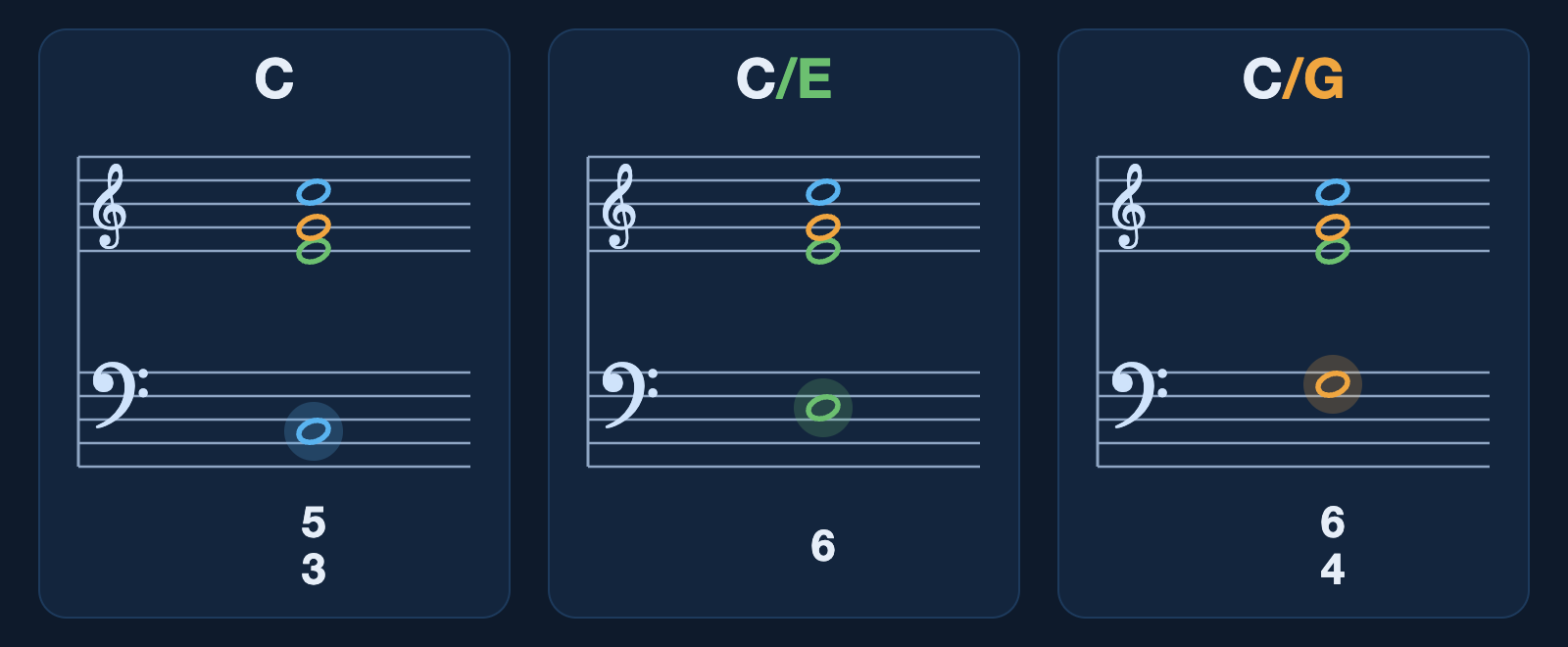
Take the C major triad, C–E–G. Stacked in thirds, C is the root, E the third, G the fifth. Put C at the bottom and the chord is in root position. Put E at the bottom and it is in first inversion. Put G at the bottom and it is in second inversion. It is still C major every time.
You need the root before you can name the inversion. If that step still feels slow, start with how to identify piano chords, which covers finding the root and naming the chord. This article picks up from there. For a textbook treatment, see Puget Sound's Inverted Triads.
How do you identify a chord inversion by the bass?
- Collect the pitch classes. Ignore octaves and doublings: E3, G4, C5, E5 gives you E, G, C.
- Stack them in thirds to find the root: C–E–G, so the root is C.
- Find the lowest sounding note. Here it is E3.
- Ask what that note is in the chord. Root, third, fifth or seventh.
- Name the position: third in the bass, so first inversion.
The upper voices do not matter. Bass E with G–C above, or bass E with C–G–E above, is first inversion both times. Students often confuse inversion with soprano position (which note is on top). The inversion lives in the bass only.
How are chord inversions written?
You will meet three systems. Slash chords (lead sheets, pop charts) write the chord, a slash, then the bass note: C/E. Figured bass lists intervals above the bass: 6 means a sixth (and a third) above it. Roman numerals with figures combine function and inversion: I6. Puget Sound's pages on figured bass inversion symbols and lead sheet symbols list the conventions.
| Position | Bass note | Figured bass | Roman (C major) | Symbol |
|---|---|---|---|---|
| Root position | C (root) | 5/3 (usually omitted) | I | C |
| First inversion | E (third) | 6 (full: 6/3) | I6 | C/E |
| Second inversion | G (fifth) | 6/4 | I6/4 | C/G |
A slash chord is not always an inversion. C/D puts a note in the bass that is not in the chord at all. When the bass note belongs to the chord, the slash chord and the inversion say the same thing.
What are the inversions of a seventh chord?
A seventh chord has four notes, so it has three inversions. Take G7 in C major: G–B–D–F.
| Position | Bass note | Figured bass | Roman (C major) | Symbol |
|---|---|---|---|---|
| Root position | G (root) | 7 | V7 | G7 |
| First inversion | B (third) | 6/5 | V6/5 | G7/B |
| Second inversion | D (fifth) | 4/3 | V4/3 | G7/D |
| Third inversion | F (seventh) | 4/2 (or 2) | V4/2 | G7/F |
V4/2 has a built-in consequence: the seventh, F, is in the bass, and it resolves down by step to E. So V4/2 normally moves to I6, not to root-position I. The voice leading rules article explains why the seventh falls.
Why do composers use inversions?
A smoother bass line. Root-position chords make the bass leap. Inversions let it walk. C – G/B – Am gives the bass C–B–A, a plain stepwise descent. In Roman numerals: I – V6 – vi. Pop songwriters use the same trick with slash chords.
The cadential 6/4. Before V at a cadence, composers often write the tonic chord over the dominant bass: C/G (I6/4) → G (V) → C (I). The bass sits on G through the first two chords while the upper voices move from C and E down to B and D. Many textbooks treat that 6/4 as a decoration of V rather than a real tonic chord; see The Cadential Six-Four Chord. In functional harmony terms it is still dominant.
The passing 6/4. A 6/4 can also fill a gap between two positions of the same chord, with the bass moving by step: I – V6/4 – I6 gives the bass C–D–E. Outside the cadential, passing, pedal and arpeggiated patterns, textbooks treat 6/4 chords with care, and so should you on an exam.
How do you hear chord inversions?
Most listeners follow the melody, the top line. To hear inversions, listen to the bass, the note people ignore.
- Sing the lowest note after each chord. If you can sing it, you can name it.
- Compare with the root. Play the chord, then its root alone. If the bass you sang matches, it is root position.
- Learn the colors. Root position sounds settled. First inversion sounds lighter and less final. A cadential 6/4 sounds unstable, as if it wants to move to V.
- Follow bass lines. In C – G/B – Am, sing C–B–A. A stepwise bass under familiar chords usually means inversions.

A practice routine for chord inversions
- Write first. On paper, spell a triad in all three positions and label each: figures, Roman numeral, slash symbol.
- Play what you wrote, exactly as voiced, on a keyboard.
- Check your answer. A chord finder like Michord shows the chord and its inversion; compare it with your label.
- Add seventh chords. Write V7, V6/5, V4/3, V4/2 in C, and resolve each to I or I6.
- Realize a short figured bass, such as C–B–C with figures 5/3, 6/5, 5/3 (I – V6/5 – I).
- Ear pass: play random inversions with your eyes closed and sing the bass before naming the position.
The tool is an answer key. The exam room has no app, so the thinking has to happen on paper first. More exam planning is in the music school audition preparation guide.

What does Michord do with inversions, and what doesn't it do?
Play a chord on a MIDI keyboard, the on-screen piano or your computer keyboard, and Michord names it. It recognizes chords from triads to 13ths, including sus, add, altered, diminished and augmented chords, as well as first, second and third inversions and slash chords, up to six notes, with alternate interpretations.
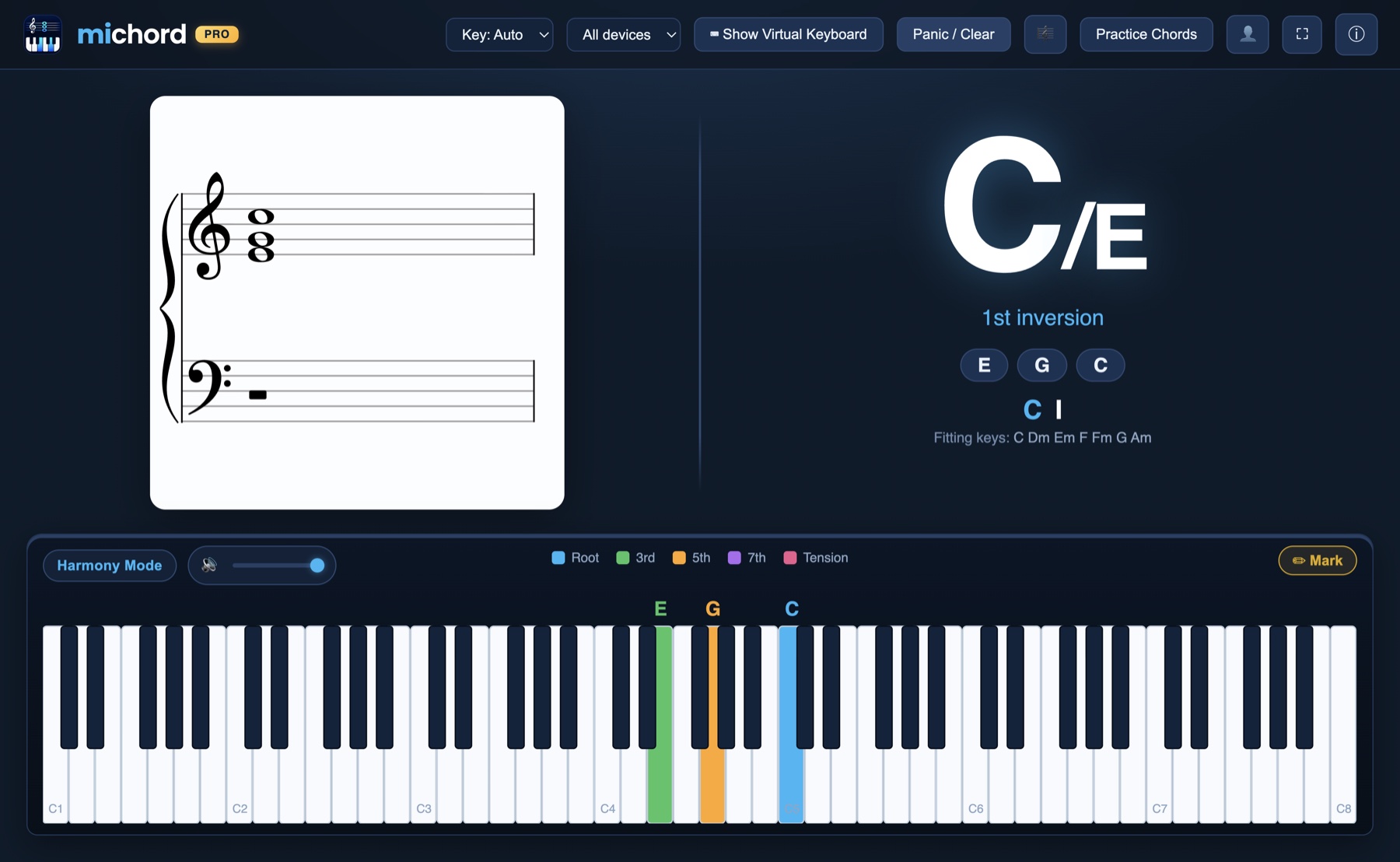
- It names the inversion and the slash bass (C/E, "1st inversion"). The Roman numeral appears as plain I; you add the figure (I6) in your written analysis yourself.
- It is rule-based, not AI. It analyzes the notes you play.
- It does not read paper, photos or audio files. You enter chords by playing them.
- Inversion and slash-chord recognition is a subscription feature ($2.99/month or $22.99/year, cancel any time). The free plan (no credit card) covers MIDI keyboard, on-screen piano and computer keyboard input, a real grand piano sound and note names of the keys you press; each launch also gives two minutes of full access.
- Desktop only: macOS on Apple Silicon and Windows 10/11. No mobile app.
Which mistakes are most common?
- Reading the top note instead of the bass. The soprano never decides the inversion.
- Letting the upper voices fool you. A spread voicing over E is still first inversion.
- Mixing up the seventh-chord figures. 6/5 is first inversion, 4/3 second, 4/2 third. Count up from the bass to check.
- Resolving V4/2 to root-position I. The bass F wants E, so the usual target is I6.
- Labeling every 6/4 as tonic. A cadential 6/4 behaves like V.
How can teachers use this in class?
Put the screen on a projector and play one chord in three positions: the class watches the symbol change from C to C/E to C/G while the role colors show which note moved to the bass. With the subscription you can also record the screen with audio (MP4) and share it as a study clip.
Conclusion
Chord inversions come down to one question: which chord member is in the bass? Answer it, and the figures, the Roman numeral and the slash symbol follow. Practice on paper, check at the keyboard, and train your ear to follow the lowest line. For the bigger picture, see the music theory guide.
Play any chord and see its inversion and slash bass on screen.
Download MichordFAQ
How do you identify a chord inversion?
Find the root, then look only at the lowest note. Root in the bass is root position, third in the bass is first inversion, fifth is second inversion, and the seventh of a seventh chord is third inversion.
What do the figured bass numbers 6 and 6/4 mean?
They list intervals above the bass. 6 (short for 6/3) means first inversion; 6/4 means second inversion. Root position is 5/3 and is usually left unfigured.
What are the inversions of a seventh chord called?
Root position 7, first inversion 6/5, second inversion 4/3, third inversion 4/2 (often just 2). For G7 in C major: V7, V6/5, V4/3 and V4/2.
What is a cadential 6/4?
A tonic chord in second inversion over the dominant bass, right before V at a cadence: C/G to G to C in C major. The bass stays on G, and many teachers analyze the 6/4 as a decoration of V.
Does the order of the upper notes change the inversion?
No. Only the lowest note decides the inversion. E in the bass with G and C above, or with C, G and E above, is first inversion either way.
Does Michord show inversions for free?
No. Chord symbols and inversions, including slash chords, come with the subscription: $2.99/month or $22.99/year, cancel any time. The free plan (no credit card) covers MIDI keyboard, on-screen piano and computer keyboard input, a real grand piano sound and note names.